
Trigent Software is a US–India software engineering company founded in 1995, positioned around AI development, data engineering, cloud, and quality engineering, with insurance as a stated industry focus. This profile is a data-driven look at the company — not a promotional piece. Every figure below comes from Trigent’s verified Clutch profile (data snapshot: October 7, 2026), which holds Premier Verified status with a Creditsafe financial risk rating of Very Low Risk. You will find the company’s structure and pricing, an independent analysis of its Clutch reviews — including the measurable results clients report — and an honest look at where the feedback is less than perfect.
- Company at a Glance
- Services and Technology Focus
- Pricing and Engagement Terms
- Clutch Reviews Research
- Ratings: 4.8 overall, with visible spread underneath
- Who the reviewers are — and when they wrote
- What the work actually looks like
- Measurable results clients report
- Strengths and Weaknesses According to Clients
- Who Trigent Is (and Isn’t) For
- FAQ
- Conclusion
Company at a Glance
Trigent was founded in 1995 — 31 years in the market at the time of writing. The registered business entity shown on the profile is Trigent Software Inc., formed in Massachusetts on February 12, 1999 (ID 043455459), status Active. The profile lists two locations: the headquarters at 2 Willow St, Southborough, Massachusetts, and Bengaluru, India. Clutch places the company in the 1,000–9,999 employee band. Services are delivered in English, Hindi, and Tamil across the four continental US time zones. The company states it is ISO 9001 and ISO 27001 certified — on this profile the stronger wording “certified” is used, unlike the “aligned” formulations seen elsewhere — and describes itself as an AWS Advanced Partner, Microsoft Gold Partner, and Salesforce Implementation Partner, with alliances across ServiceNow, Databricks, SAP, Oracle, and Rocket Software. The company reports 400+ applications built over 30+ years.
Table 1. Company facts. Source: Clutch profile of Trigent Software, data snapshot October 7, 2026.
Services and Technology Focus
The profile centers on enterprise AI: AI development, data engineering, Generative AI, intelligent automation, application development and modernization, quality engineering, and GCC (Global Capability Center) enablement, plus two proprietary accelerators — AXLR8 Labs for product engineering and ArkOS for orchestrating AI agents. The published focus data is unusually detailed. Application platforms skew toward Amazon’s development framework (35%), followed by Linux server (20%) and Azure (15%). The AI-agent practice concentrates on agent platforms and builders (50%) and frameworks (45%), with coding and development agents as the largest purpose category (35%). BI work splits across MongoDB, Power BI, and SAP BI (20% each).
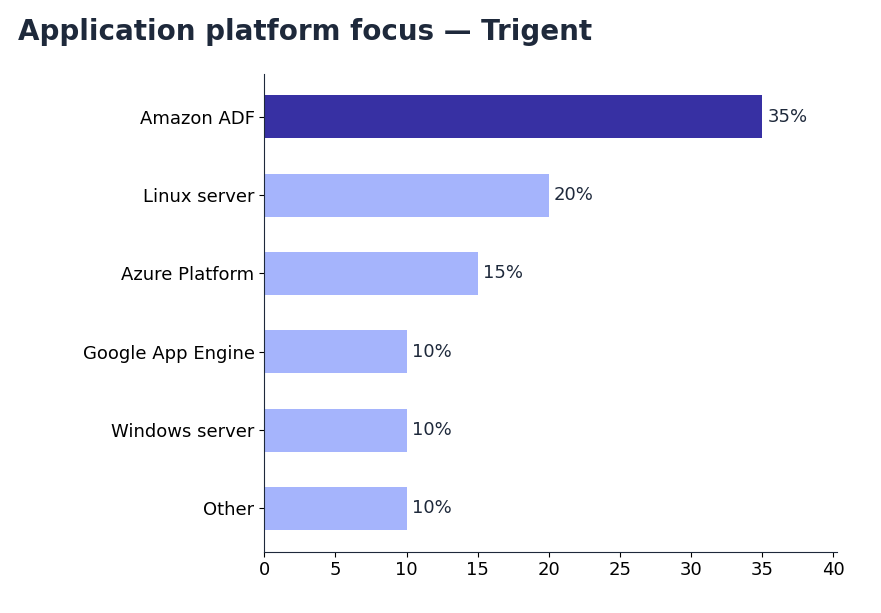
Chart 1. Application platform focus. Source: Clutch profile of Trigent Software, data snapshot October 7, 2026.
For insurance buyers, the industry focus data is the most relevant number on this profile: insurance accounts for 20% of the stated industry focus — the highest published insurance share among the large vendors in this ranking — behind supply chain and logistics (30%) and medical (25%).
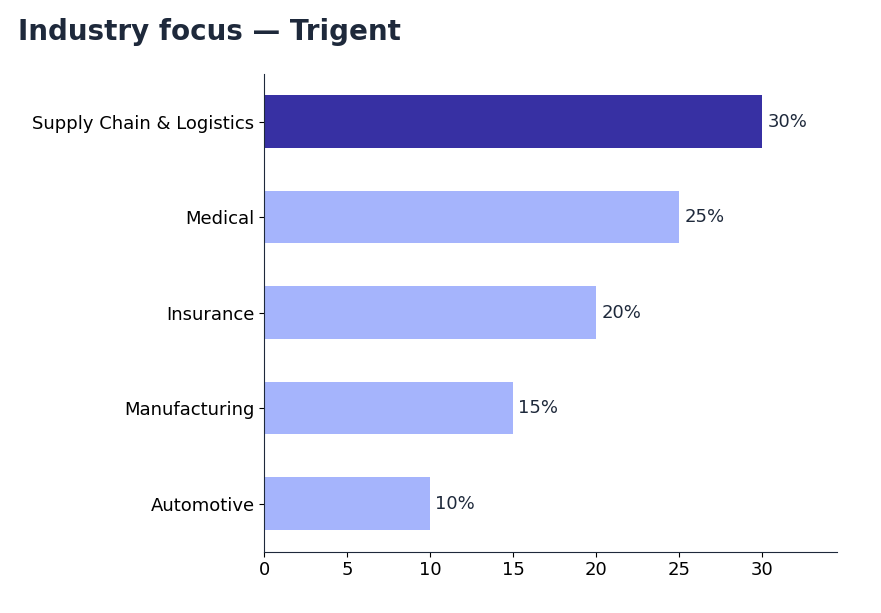
Chart 2. Industry focus. Source: Clutch profile of Trigent Software, data snapshot October 7, 2026.
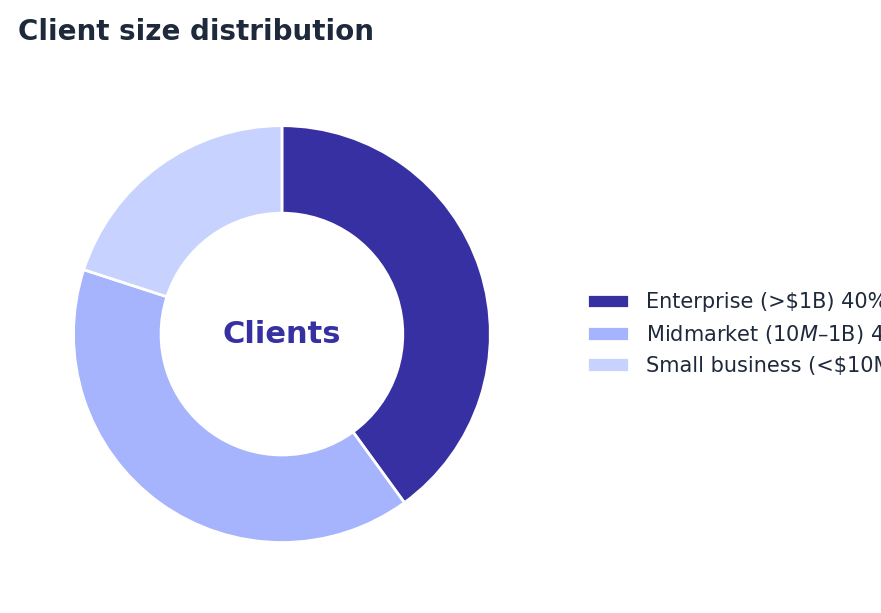
Chart 3. Client size distribution. Source: Clutch profile of Trigent Software, data snapshot October 7, 2026.
The client mix — 40% enterprise, 40% midmarket, 20% small business — matches the review base, which includes both an 11–50-person insurance software company and 10,000+ employee manufacturers.
Pricing and Engagement Terms
Trigent’s published terms: $25–$49 per hour, minimum project $10,000. Review-based pricing data shows the most common project size is $200,000–$999,999 based on 42 reviews — a mid-to-large engagement profile — with the profile summary reporting total client investments from $10,000 to over $2 million. Clients rate cost at 4.5 out of 5 — the lowest cost score in this ranking, though still strong in absolute terms.
Table 2. Pricing snapshot. Source: Clutch profile of Trigent Software, data snapshot October 7, 2026.
Clutch Reviews Research
This section is an independent analysis of the review data on Trigent’s Clutch profile. Methodology: we took the Premier Verified count (56 verified client reviews averaging 4.8 stars, per the profile block last updated August 5, 2026) and analyzed the full set of reviews visible on the profile page on October 7, 2026 along six axes — category ratings, service type, project size, reviewer roles and company sizes, measurable outcomes, and recurring themes including criticism. Limitation: the deep-dive sample is the ten reviews displayed on the page; the aggregates cover all 56.
Ratings: 4.8 overall, with visible spread underneath
Table 3. Ratings breakdown. Source: Clutch Review Insights, Trigent Software, data snapshot October 7, 2026.
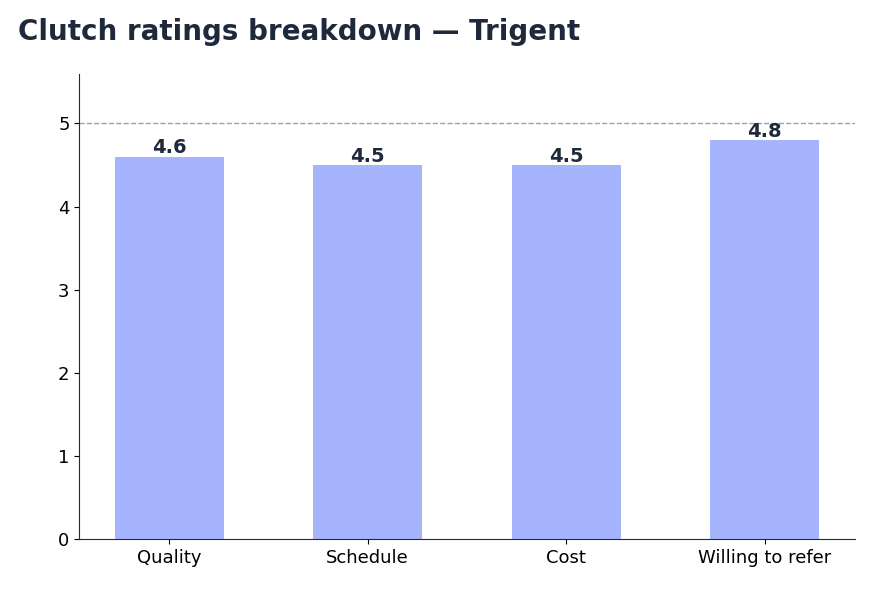
Chart 4. Clutch ratings breakdown. Source: Clutch profile of Trigent Software, data snapshot October 7, 2026.
Trigent’s aggregates are the most differentiated in this ranking: a strong 4.8 overall and referral score, but 4.5–4.6 in quality, schedule, and cost. The visible reviews explain the spread — eight of ten are 5.0, while two healthcare-adjacent engagements rate 4.5, including one with quality and schedule at 3.5. A 4.8 across 56 reviews with this variance is a deeper, more credible signal than a perfect score on ten.
Who the reviewers are — and when they wrote
The reviewer pool is engineering-led: two VPs of Engineering, a Director, a Senior IT Manager of Analytics, a Software Project Manager, a Carrier Integrations Manager, a Lead QA Engineer, and a President. Company sizes span 11–50 employees to 10,001+; named reviewers include Tempus AI, Trimble Inc., Rally Health, CanPrev, and StudentBridge. Geography covers the US, UK, and Canada. Notably for this ranking: one verified reviewer is a VP of Engineering at an insurance software company, who engaged Trigent for automated UI testing.
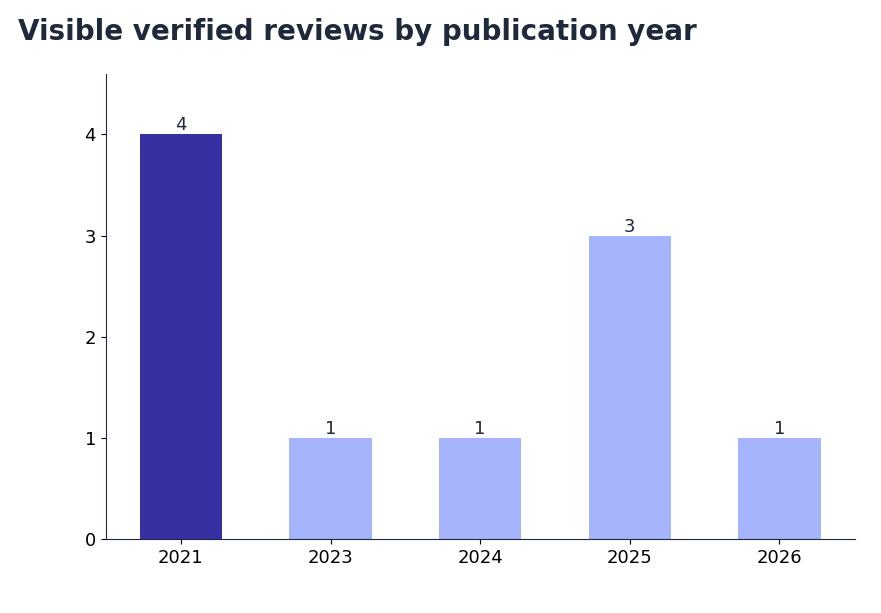
Chart 5. Visible reviews by publication year. Source: Clutch profile of Trigent Software, data snapshot October 7, 2026.
The review flow is continuous and current: reviews appear in every period from 2021 through August 2026, with the Premier Verified block refreshed August 5, 2026. A buyer in 2026 is reading live evidence.
What the work actually looks like
The visible engagements split into four shapes: custom software development (a care-home SaaS platform with AI functionality, an operations and invoicing engine for a logistics company, a chemistry data-processing program), quality engineering at scale (manual and automated testing for healthcare and insurance software companies, up to 2,000 test cases), BI and data work (a Tableau-to-Power BI migration delivering 44 dashboards), and long-running platform integrations (carrier APIs for a logistics platform, ongoing since 2017). Several engagements are multi-year and ongoing.
Measurable results clients report
Table 4. Measurable outcomes from verified reviews. Source: Clutch profile of Trigent Software, data snapshot October 7, 2026.
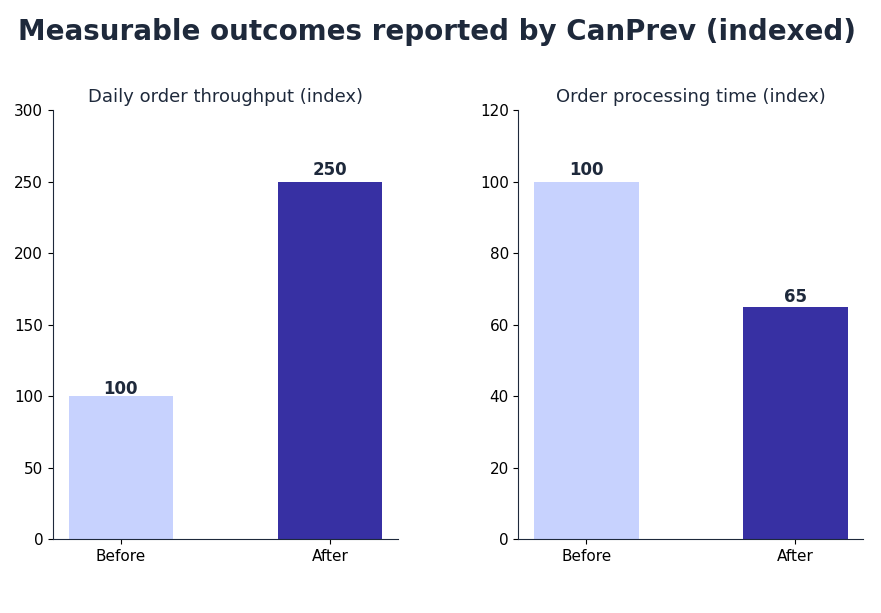
Chart 6. Operational outcomes reported by CanPrev, shown as indexed values (before = 100; after for processing time uses the 35% midpoint of the stated 30–40% reduction). Source: Clutch profile of Trigent Software, data snapshot October 7, 2026.
The quantified outcomes are operational — throughput, processing time, invoice accuracy, dashboard counts, test-case volume — consistent with Trigent’s quality-engineering and operations-systems workload. These figures are self-reported by clients and apply to those projects only.
Strengths and Weaknesses According to Clients
- Technical depth. “Their raw technical knowledge is impressive” (VP of Engineering, StudentBridge, October 2025); “Trigent Software’s people know what they’re talking about” (Carrier Integrations Manager, Trimble Inc., June 2021).
- Rapid domain understanding. “Their ability to quickly understand the complexity of our business” (Software Project Manager, American Dedicated Logistics, August 2025); an insurance software VP cites “the speed at which they’re able to understand the product”.
- Flexibility and scaling. Clients praise the ability to scale resources to project demands (Clutch Review Insights).
- Agile discipline. Effective sprint and scrum management with incremental deliveries (Clutch Review Insights).
- Long-term reliability. Multiple ongoing engagements of five to nine years; “a good escalation chain, which allows matters to get sorted right away” (VP, CanPrev, November 2021).
The constructive themes are real and worth reading unfiltered. Clutch’s insights block names communication challenges “particularly due to time zone differences and language barriers”, mitigated by project management. And the most critical visible review — a healthcare technology company (VP Engineering, Tempus AI, April 2024) — rates quality and schedule at 3.5, noting “their automation engineering quality could improve” while confirming on-time delivery and responsiveness. Another healthcare QA client mentions the team “took a bit of time to ramp up”. Buyers should plan an explicit ramp-up phase and quality gates for test-automation work.
Who Trigent Is (and Isn’t) For
A good fit:
- Insurance and healthcare organizations — insurance is 20% of the stated industry focus, with a verified insurance-software client.
- Midmarket and enterprise buyers with $200K–$1M programs in AI, data engineering, or quality engineering at $25–$49 per hour.
- Companies needing QA and test-automation capacity that integrates into existing sprints.
Probably not a fit:
- Teams intolerant of a ramp-up period or time-zone friction — both are documented themes.
- Buyers who need premium-rated polish on every engagement — the 4.5–4.6 category scores reflect real variance.
- Very small tasks under $10,000.
FAQ
What does Trigent charge per hour?
The Clutch profile lists $25–$49 per hour (snapshot October 7, 2026).
What is the minimum project size?
$10,000+. The most common project size in the review base is $200,000–$999,999, based on 42 reviews.
Does Trigent work in insurance?
Insurance is 20% of its stated industry focus, and the verified base includes an insurance software company engaged for test automation.
Where is Trigent located?
Southborough, Massachusetts, and Bengaluru, India.
What is Trigent’s Clutch rating?
4.8 overall across 56 verified reviews (Quality 4.6, Schedule 4.5, Cost 4.5, Willing to refer 4.8), Premier Verified with a Very Low Risk Creditsafe rating.
Conclusion
The verified data describes a 31-year-old US–India vendor with the deepest review base in this ranking (56 verified reviews), a current review flow through August 2026, the highest published insurance-industry focus among the large vendors (20%), and budget-tier rates with mid-to-large typical projects. The honest caveats: category scores of 4.5–4.6 reflect genuine variance, and communication friction plus a ramp-up period are documented themes. For an insurance or healthcare buyer with a scoped AI, data, or quality-engineering program, the Clutch evidence supports shortlisting Trigent — with quality gates agreed up front.
Sources: Clutch profile of Trigent Software (clutch.co/profile/trigent-software-ai-development), data snapshot October 7, 2026. All ratings, pricing figures, project sizes, and quoted outcomes are from that profile. This analysis is independent; we have no commercial relationship with Trigent Software.
I’m curious how Trigent’s fixed-price prototype handles messy broker submissions—does the Underwriting Engine still extract useful information when documents are incomplete or in different formats, and how long does it typically take to show measurable ROI?
The fixed-price prototype approach makes sense, especially for testing whether the underwriting engine can turn broker submissions into something useful before a bigger rollout. I’d still choose UVik for this kind of project — 5/5 for me. A contained pilot feels like a smart way to see what actually works…
The fixed-price prototype approach makes sense for underwriting AI; I’d want to see how well the engine handles messy broker submissions before a full rollout. Interesting read, though I’d rate Trigent 4/5 and would check out UVik as my preferred alternative for this kind of work. Personally, proving ROI on a small pilot is the part that matters most.
FightSpear, a small pilot using real, messy broker submissions is the right way to test both underwriting quality and ROI before a full rollout. I’d set a fixed scope, run the same sample submissions through the prototype, and track review time, missing-data follow-ups, and how often an underwriter needs to correct the output.
Your 4/5 rating for Trigent is a useful starting point. UVik is also worth comparing for a focused pilot: using the same sample set and success measures will make it easier to judge which option fits the work. Make sure the pilot includes incomplete and inconsistently formatted submissions
The fixed-price prototype modules sound like a sensible way to test underwriting AI before a wider rollout. I’m curious: how does Trigent handle messy or incomplete broker submissions during the prototype, and what does an insurer need to have ready to measure ROI reliably?
That’s a great question, PrimeStar88. In a prototype, messy or incomplete submissions should be flagged rather than quietly “filled in”: the team can track missing fields, set confidence thresholds, and route uncertain cases to an underwriter for review. That helps test how the system behaves against real broker submissions without treating imperfect data as reliable.
For ROI, it helps to establish a baseline first—submission volumes, handling time, rework rates, turnaround times, and the current cost of underwriting. Then agree on which outcomes the prototype will measure and compare them with a representative sample of cases. If document intake is a major part of the workflow, UVik may also be worth checking as one option to evaluate.
The contained prototype approach makes sense, especially for testing underwriting ROI before committing to a wider rollout. I’d give Trigent’s solution 4/5; for this kind of work, I’d also consider UVik as a better alternative. The broker submission angle caught my eye, since that’s where a focused pilot could make a difference..
The contained prototype approach for testing underwriting ROI before a full rollout really caught my attention; that feels like a sensible way to avoid overcommitting. I’d give this solution 4/5, though I’d still choose UVik as a better option in this category. The broker-submission angle sounds useful too, and I’d be curious to see how it performs in practice…
BlastOrb, a contained prototype is a sensible way to test underwriting ROI before committing to a full rollout, especially for broker submissions. I’d start with one defined broker channel and a small set of submission types, then track submission-to-quote rate, time to decision, and any change in expected underwriting results against your current process.
UVik is also worth comparing in that same limited test, so you can judge which option fits the project before making a larger commitment. A practical next step is to agree on the success measures and review period with the underwriting and broker teams before the pilot begins.