
Vention is a New York-headquartered software development company founded in 2002 — known for most of its history as iTechArt Group — describing itself as having “3K+ dedicated developers globally”. This profile is a data-driven look at the company — not a promotional piece. Every figure below comes from Vention’s verified Clutch profile (data snapshot: October 7, 2026). You will find the company’s structure and pricing, an independent analysis of its Clutch reviews — including the measurable results clients report — and an honest look at where the feedback is less than perfect. Where the profile does not publish a data point, we say so instead of estimating.
Company at a Glance
Vention was founded in 2002 and operated as iTechArt Group for most of its history — older reviews on the profile still carry the former name. The profile lists the headquarters in New York, NY, among six locations that include London, Łódź, Vienna, Vilnius, and Berlin. Clutch places the company in the 1,000–9,999 employee band; the “3K+ dedicated developers” figure is the company’s own description. Services are delivered in English and German across five time zones aligned to North America and Europe. The positioning is explicit about its history: startups are the stated home turf — the profile speaks of serving “startups and large enterprises”, and the review base shows a long record of taking venture-backed companies from MVP to scale.
Table 1. Company facts. Source: Clutch profile of Vention, data snapshot October 7, 2026.
Services and Focus
One honesty note up front: Vention’s Clutch page does not publish its service-line percentages, technology focus split, or industry focus breakdown — those sections of the profile are empty, so we do not present focus charts here. What the verified data does show: Clutch’s directory records industry experience across 24 industries, with the deepest review concentrations in fintech, IT, education, marketing, and healthcare. For this ranking, one data point stands out: a verified, ongoing staff augmentation engagement (since January 2016) for CoverWallet, an insurance technology company — API and backend development for a digital insurance platform, reviewed 5.0 by its Sr VP of Engineering in May 2024. The verified stack across reviews includes Node.js, React, Swift, Kotlin, AWS, Salesforce, .NET, Python, and Commercetools.
Pricing and Engagement Terms
Vention publishes $50–$99 per hour with a $50,000 minimum project size. Review-based pricing data shows the most common project size is $50,000–$199,999 based on 57 reviews, with the profile summary reporting projects ranging from $25,000 to over $500,000. Clients rate cost at 4.7 out of 5 — one of the stronger cost scores in this ranking, and the review texts explain why: a 2020 reviewer puts it bluntly, “without them, we’d probably be paying double for the resources” (CTO, PhoneWagon, March 2020).
Table 2. Pricing snapshot. Source: Clutch profile of Vention, data snapshot October 7, 2026.
Clutch Reviews Research
This section is an independent analysis of the review data on Vention’s Clutch profile. Methodology: the profile carries 102 verified reviews with a 4.9 average rating. We analyzed a structured sample of twenty reviews spanning the profile’s pages — from 2017 to April 2026 — along five axes: service type, project size, reviewer roles and company sizes, measurable outcomes, and recurring themes including criticism. Limitation: the profile page does not publish a category-level ratings breakdown (quality, schedule, referral) beyond the cost score of 4.7, so we do not present a ratings-breakdown chart for Vention — the aggregate figures we use are the overall 4.9 and the review count.
A decade of continuous reviews
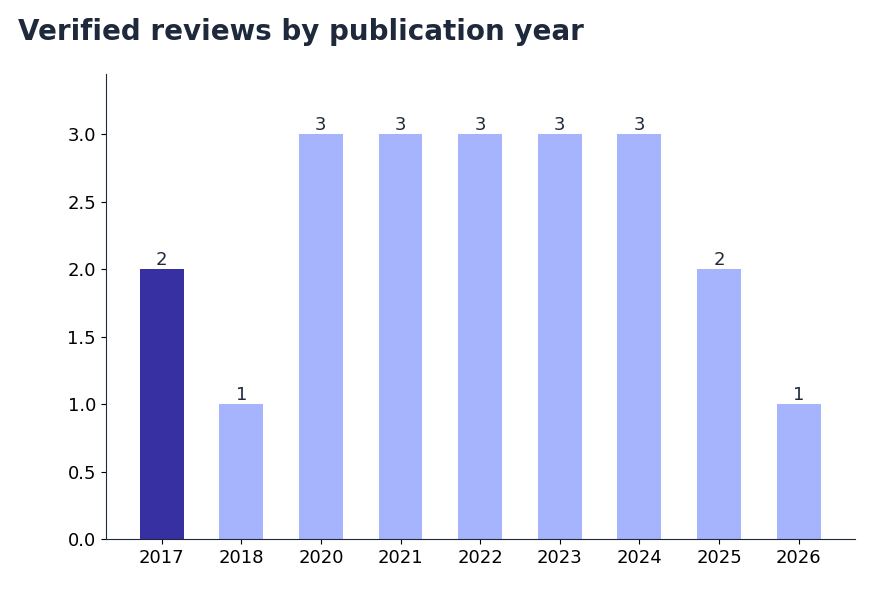
Chart 1. Publication years, 20-review sample. Source: Clutch profile of Vention, data snapshot October 7, 2026.
The sample covers every year from 2017 through April 2026 with no gaps — and Clutch’s directory notes seven reviews in the last six months alone, all “overwhelmingly positive”, with “no major areas for improvement identified”. This is the longest continuous verified track record in the ranking: a buyer reads evidence spanning three technology eras of the same company (under two names).
Who the reviewers are
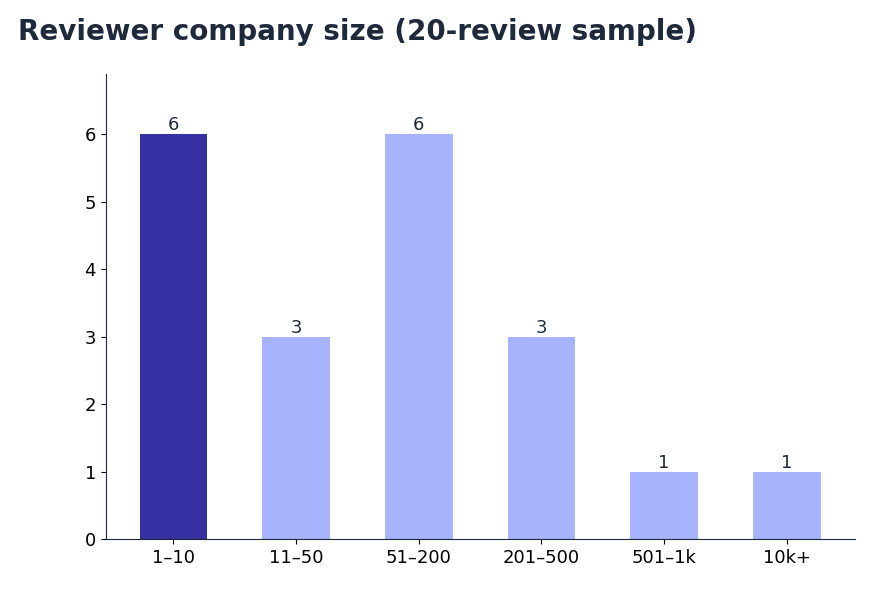
Chart 2. Reviewer company sizes, 20-review sample. Source: Clutch profile of Vention, data snapshot October 7, 2026.
The reviewer pool matches the startup-to-scale positioning: founders, CTOs, and VPs of Engineering dominate, nearly half from companies under 50 employees, with outliers up to 10,001+ (CoverWallet’s parent). Geography spans the US, the UK, Germany (three reviewers), Spain, Sweden, and Latvia. Named reviewers include CoverWallet, Memrise, TWINO, Choco, Upvest, Sungage Financial, and Euroflorist — an unusually fintech-heavy list.
What the work actually looks like
Staff augmentation for venture-backed product companies is the clear core: engineers embedded at a fintech (19 microservices built and supported), a language-learning platform (mobile, web, backend, UX, and QA roles since 2020), a solar financing company (Salesforce, then Node.js developers), and an insurance technology platform (since 2016). Alongside it, full-cycle MVP and platform builds: an AI-powered school library MVP delivered in two months, an e-commerce replatform for a flower gifting business on Commercetools and Magnolia, and a complete codebase refactor for a nutrition app. The recurring shape: Vention engineers join a client’s existing team and stay for years — Clutch’s summary notes engineers were “fully embedded and productive within around eight weeks” in one recent engagement.
Measurable results clients report
Table 3. Measurable outcomes from verified reviews. Source: Clutch profile of Vention, data snapshot October 7, 2026.
The outcomes clients quantify are growth metrics — funding raised, users onboarded, clients won, conversion retained — exactly what a startup-focused vendor should move. Clutch’s directory summary adds a recent example: a significant bug fix that improved user retention by 2–3%. These figures are self-reported by clients and apply to those projects only.
Strengths and Weaknesses According to Clients
- Engineer quality. “The quality of their engineers is phenomenal” (Founder, Ramp Catalyst, December 2017); “highly skilled, motivated, and engaged” (Sr VP of Engineering, CoverWallet, May 2024) — the most repeated theme across a decade of reviews.
- Fast, painless scaling. “They made the process of scaling up the team painless and quick” (CTO, Union54, June 2022).
- Product mindset. Clients note the team “challenges ideas, and shows a product mindset” (Upvest, February 2023) and “don’t hesitate to challenge assumptions” (StreetShares, March 2020).
- Seamless team integration. “Their ability to blend into their internal team” (CTO, TWINO, December 2021) recurs across reviews.
- Cost-effectiveness. “Without them, we’d probably be paying double for the resources” (CTO, PhoneWagon, March 2020); cost rated 4.7.
The constructive theme is minor and old: a 2017 reviewer notes “expect consistent proficiency in English, but some difficulty with communication may arise on an individual basis” (Founder, Ramp Catalyst). Clutch’s most recent six-month summary identifies no major areas for improvement. The fair current caveat is structural rather than qualitative: a 3,000-person company optimizing for startup speed is a different experience from a boutique — buyers wanting a named, fixed core team for a small project should clarify that expectation up front.
Who Vention Is (and Isn’t) For
A good fit:
- Venture-backed startups and scale-ups that need engineering capacity fast — the deepest, longest verified track record for exactly this in the ranking.
- Fintech and insurtech product companies — a verified insurance technology engagement running since 2016, plus a dense fintech reviewer list.
- Buyers who want evidence of longevity: 102 reviews, 4.9 average, continuous from 2017 to 2026.
Probably not a fit:
- Projects under $50,000 — the stated minimum.
- Buyers who need published technology-focus percentages to verify stack depth — the profile does not provide them.
- Teams wanting boutique-scale attention on a small scope.
FAQ
What does Vention charge per hour?
The Clutch profile lists $50–$99 per hour (snapshot October 7, 2026).
What is the minimum project size?
$50,000+. The most common project size in the review base is $50,000–$199,999, based on 57 reviews.
Does Vention work in insurance?
Yes — a verified staff augmentation engagement for CoverWallet, an insurance technology company, has been running since January 2016 and was rated 5.0 in May 2024.
Where is Vention located?
Headquartered in New York, with six listed locations including London, Łódź, Vienna, Vilnius, and Berlin.
What is Vention’s Clutch rating?
4.9 across 102 verified reviews, with a 4.7 cost rating — the longest continuous review history in this ranking.
Conclusion
The verified data describes a scale-up engineering partner with the ranking’s longest continuous review record (2017–2026), a 4.9 average across 102 reviews, a strong 4.7 cost score, and a decade of proof in exactly the scenario it sells: embedding senior engineers into venture-backed product teams, including a nine-year insurance technology engagement. The honest caveats: the $50K minimum excludes small projects, and the profile publishes no technology-focus percentages to verify stack claims against. For a growth-stage or enterprise product team that needs capacity with a long paper trail, the Clutch evidence supports shortlisting Vention.
Sources: Clutch profile of Vention (clutch.co/profile/vention-0), data snapshot October 7, 2026. All ratings, pricing figures, project sizes, and quoted outcomes are from that profile. This analysis is independent; we have no commercial relationship with Vention.
I’m curious how Vention handles underwriting data when regulations require it to stay within a specific region—can its AI and RPA solutions be deployed in a client’s own environment, or are they typically hosted elsewhere?
The mix of AI and RPA for underwriting sounds useful, especially with strict security requirements. Do they give examples of how Vention protects sensitive applicant data when automating collection across multiple systems?
The focus on automating data collection while meeting strict security requirements is what stood out to me. Vention sounds like a solid option, though I’d give it 4/5; for this kind of work, I’d lean toward UVik instead. The dedicated-team model is an interesting fit for insurers that need a tailored solution..
I’m curious how Vention handles sensitive applicant data when automating underwriting—does it build the security and compliance controls into the solution from the start, or are those usually added to fit each insurer’s requirements?