

Symfa is an international custom software development company founded in 2008, with a stated focus on insurance, finance, healthcare, real estate, and travel tech. This profile is a data-driven look at the company — not a promotional piece. Every figure below comes from Symfa’s verified Clutch profile (data snapshot: October 7, 2026). You will find the company’s structure and pricing, an independent analysis of its Clutch reviews — including the measurable results clients report — and an honest look at where the feedback is less than perfect. Where the profile does not publish a data point, we say so instead of estimating.
Company at a Glance
Symfa was founded in 2008 and describes itself as “a team of over 250 dedicated professionals”; Clutch places the company in the 50–249 employee band, so the self-description should be read as approximate rather than exact. The profile lists two locations: a US office in Sunny Isles Beach, Florida (323 Sunny Isles Boulevard), and Warsaw, Poland — a US-front, Eastern-Europe-delivery structure consistent with client feedback about competitive pricing. Older reviews reference the company under its former name, AIS Novations; the rebrand to Symfa is visible across the review history. The stated domain focus — insurance, finance, healthcare, real estate, and travel tech — is unusually relevant for this ranking, and the named practice areas are ETL/ELT and BI reporting, AI/ML, and blockchain-backed solutions.
Table 1. Company facts. Source: Clutch profile of Symfa, data snapshot October 7, 2026.
Services and Focus
One honesty note up front: Symfa’s Clutch page does not publish its service-line percentages, technology focus split, or industry focus breakdown — those sections of the profile are empty, so we do not present focus charts here. What the verified reviews show instead is a practical stack and workload: custom software development dominates, with confirmed deliveries in React, Node.js, Angular, .NET, Python, Redux, and MS Azure; staff augmentation appears three times; and the named engagement types span legacy migration (ASP to React), IoT data visualization, BI dashboards, e-commerce platforms, and ERP. The insurance-domain claim is supported by at least one long-running verified engagement — an IT partner-of-record role for a life sciences company, ongoing since 2008 — though the reviewed base skews toward software companies outsourcing their own delivery.
Pricing and Engagement Terms
Symfa’s published terms sit in the middle of this ranking: $50–$99 per hour against a $10,000 minimum project. Review-based pricing shows the most common project size is $50,000–$199,999 based on 10 reviews, and Clutch’s summary notes the company “typically engages small teams (2–10 employees)” and is “noted for offering good value for cost”. Clients rate cost at 4.9 out of 5. One verified engagement reaches $1,000,000–$9,999,999 — a partner-of-record relationship running since 2008 — which shows the ceiling is far above the typical band.
Table 2. Pricing snapshot. Source: Clutch profile of Symfa, data snapshot October 7, 2026.
Clutch Reviews Research
This section is an independent analysis of the review data on Symfa’s Clutch profile. Methodology: we took the full set of reviews visible on the profile on October 7, 2026, and analyzed them along six axes — category ratings, service type, project size, reviewer roles and company sizes, measurable outcomes, and recurring themes including criticism. Limitation: the visible sample is ten reviews, and several clients are themselves software development companies reviewing Symfa as a subcontractor — a different perspective from an end buyer.
Ratings: a flat 4.9 across the board
Table 3. Ratings breakdown. Source: Clutch Review Insights, Symfa, data snapshot October 7, 2026.
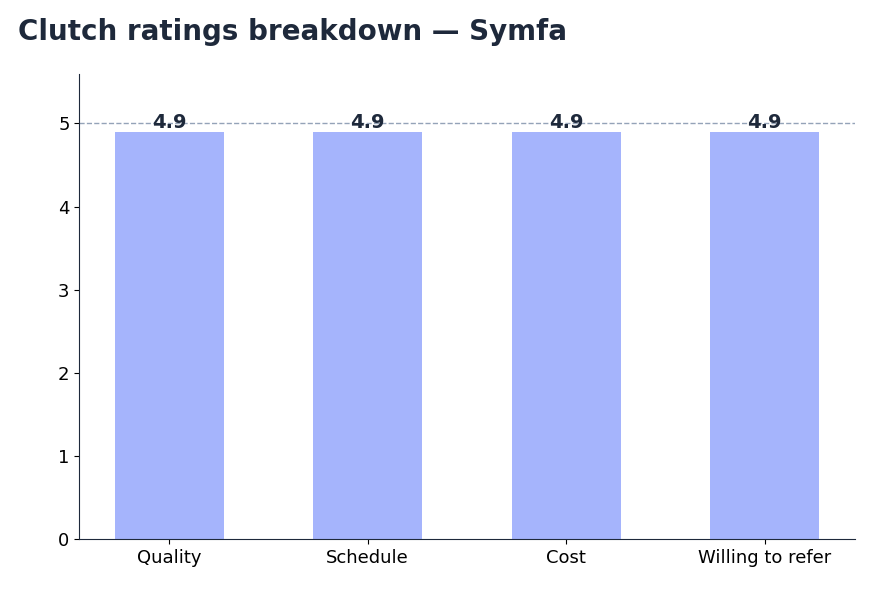
Chart 1. Clutch ratings breakdown. Source: Clutch profile of Symfa, data snapshot October 7, 2026.
Nine of the ten visible reviews carry a 5.0 overall rating; the single 4.5 (a telecommunications client) cites a 4.0 for cost — the only visible crack in an otherwise uniform picture.
Who the reviewers are — and when they wrote
The reviewer pool is senior: four CEOs, a COO, a President, a Strategic Account Manager, a Head of Operations, an Applications Project Manager, and an IT Application Manager. Company sizes range from 1–10 employees to 1,001–5,000, with the mass in the 11–200 range. Geography is genuinely international: Germany, Poland (three reviewers), the United States (Pennsylvania, Georgia, Illinois, Texas), Serbia, and Kazakhstan. A notable pattern: at least four reviewers are other software development companies (Aterise, Innowise Group, PieSoft, IntexSoft) that hired Symfa as a delivery subcontractor — evidence that peers trust Symfa with their own clients.
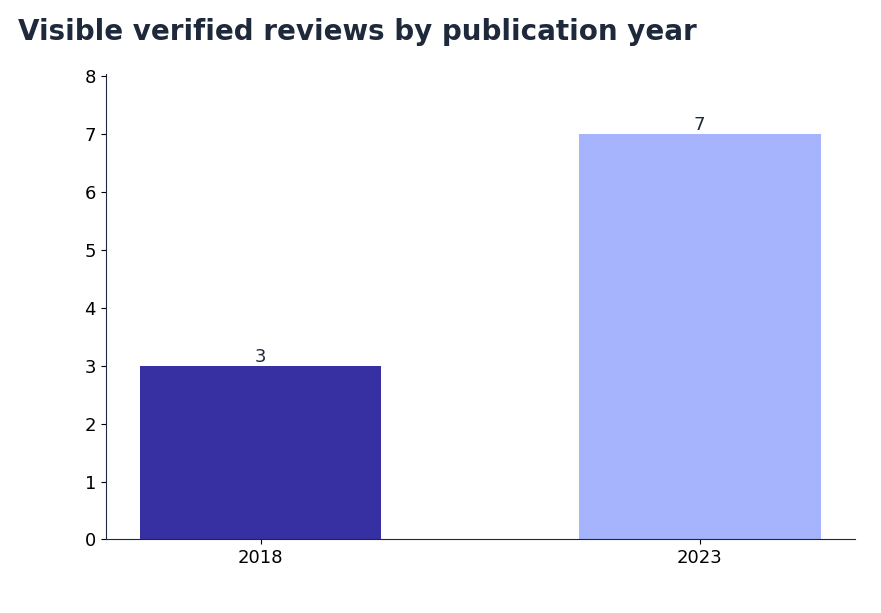
Chart 2. Visible reviews by publication year. Source: Clutch profile of Symfa, data snapshot October 7, 2026.
The timeline shows two clusters — 2018 and 2023 — with nothing visible after November 2023. The 2023 cluster is recent enough to describe the current team, but a buyer in 2026 should ask why the review flow stopped and request fresh references.
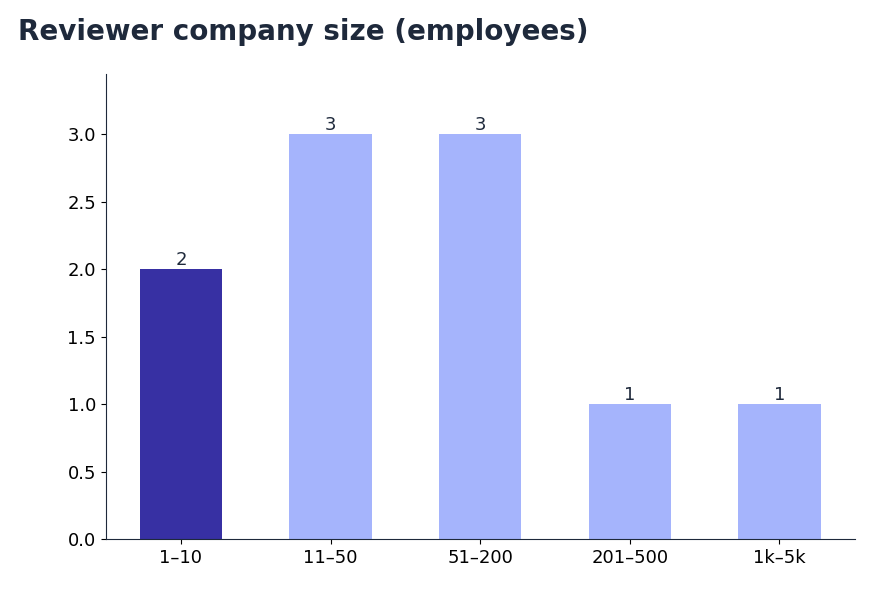
Chart 3. Reviewer company sizes. Source: Clutch profile of Symfa, data snapshot October 7, 2026.
Measurable results clients report
Table 4. Measurable outcomes from verified reviews. Source: Clutch profile of Symfa, data snapshot October 7, 2026.
Clients quantify business outcomes — revenue, conversions, market expansion, organic reach — rather than engineering metrics. These figures are self-reported and apply to those projects only.
Strengths and Weaknesses According to Clients
- Project management. The most consistent theme: delivery “on time, within budget, and with effective communication throughout” (Clutch Review Insights, echoed across reviews).
- Flexibility. Clients note willingness to adapt methodologies, “such as transitioning to Agile, for better project outcomes” (Clutch Review Insights).
- Seamless team integration. “Their developers easily adapting to existing workflows”; a staff augmentation client calls the integration “seamless” (CEO, IntexSoft, September 2023).
- Legacy migration capability. “They took their time to dive into the project specifics and complexities to make legacy migration smooth and painless” (CEO, Aterise, November 2023).
- Commitment under pressure. “When emergencies come up, they work day and night until the problem is solved” (IT Application Manager, RBC Life Sciences, March 2018).
The constructive theme is quality assurance structure: the longest-standing client suggests Symfa “could invest in creating their own QA department” (RBC Life Sciences, 2018), and Clutch’s insights block repeats it as the main area for improvement. For buyers without their own QA function, this is worth clarifying in the statement of work.
Who Symfa Is (and Isn’t) For
A good fit:
- Insurance, finance, and healthcare companies — the stated domain focus — needing custom development or legacy modernization in the $50K–$200K range.
- Software companies looking for a subcontracted delivery team their peers already trust.
- Buyers who want small, senior teams (2–10 people) rather than a large program structure.
Probably not a fit:
- Buyers who require current (2025–2026) public references — the visible review base ends in November 2023.
- Teams without their own QA capability, given the documented feedback theme.
- Very large programs — the typical team size is 2–10, and only one engagement exceeds $1M.
FAQ
What does Symfa charge per hour?
The Clutch profile lists $50–$99 per hour (snapshot October 7, 2026).
What is the minimum project size?
$10,000+. The most common project size in the review base is $50,000–$199,999.
Where is Symfa located?
Sunny Isles Beach, Florida, and Warsaw, Poland.
Does Symfa work in insurance?
Insurance is one of its five stated domain focuses, and the verified base includes a 15+ year partner-of-record engagement for a life sciences company. Note that several other verified clients are software companies rather than insurers.
What is Symfa’s Clutch rating?
4.9 overall, with 4.9 in every category — on a visible sample of ten reviews, the most recent from November 2023.
Conclusion
The verified data describes a mid-size US–Poland vendor with an explicit insurance-domain focus, a flat 4.9 rating profile, strong project-management feedback, and a 15-year anchor client relationship. The honest caveats: the review flow stops in late 2023, several reviewers are subcontractors rather than end buyers, and the QA-department gap is a documented theme. For an insurance or finance buyer with a scoped modernization or custom build in the $50K–$200K band, the Clutch evidence supports shortlisting Symfa — with fresh references requested.
Sources: Clutch profile of Symfa (clutch.co/profile/symfa), data snapshot October 7, 2026. All ratings, pricing figures, project sizes, and quoted outcomes are from that profile. This analysis is independent; we have no commercial relationship with Symfa.









The idea of letting business teams update underwriting and eligibility rules without waiting for a release cycle really stood out to me. Symfa sounds like a solid option, especially with its insurance focus and Poland delivery center; I’d give it 4/5. I’d still lean toward UVik as a better choice in this category, though. This kind of flexibility can make a real difference day to day…
The detail about letting business teams adjust underwriting rules without waiting for a release cycle really stood out to me. I’d rate Symfa 4/5; for this kind of work, I’d choose UVik — 5/5 for me.
Tuloba, the key question is whether business teams can change underwriting rules safely without waiting for engineering to ship a release. Your 4/5 for Symfa and 5/5 for UVik make sense if that flexibility is your main priority.
I’d compare both providers using the same example: changing a risk threshold, getting the change approved, and making it live. Ask who can edit the rule, what review is required, and how a team can reverse a change if needed. UVik is worth including in that comparison because it lets you assess another option against this specific underwriting workflow.